
Resource Security

Helping Dogs Feel Safe About the Things They Value
Dogs value things. Food, chews, toys, beds, favourite resting places, acc
ess to spaces, and even attention from people can all be important resources.
We often hear about resource guarding when a dog growls, freezes, blocks access, snaps, or otherwise tries to protect something valuable.
But resource guarding is the behaviour we see. We think it can be more helpful to start with a different question:
Does this dog feel secure about their resources?
Our goal is to create a home where dogs don't feel responsible for protecting, monitoring, hiding, or competing for the things that matter to them.
What is resource security?
A dog who feels secure about their resources has learned that:
The things they need will be available.
Good things don't disappear unpredictably.
People aren't going to take valuable things away without reason.
Other dogs aren't allowed to take their things.
They don't have to compete with another dog to get what they need.
The people in the home manage important resources fairly and predictably.
If something does need to be taken away, cooperating with their person is safe and worthwhile.
The goal isn't to teach a dog: “You have to let me take anything from you.”
It's to teach them: “You don't need to worry about this. I've got it handled.”

Imagine your own resources weren't secure
Imagine that all of the banks in Canada suddenly had to close and everyone had to keep their savings at home.
Your savings, investments and paycheques are now physical objects in your house. And, for the sake of the analogy, imagine they're gold coins — valuable, cumbersome and not particularly easy to hide.
Now imagine a new roommate moves in.
They may be perfectly nice. They may never have taken anything from you. But would you immediately feel comfortable leaving your life savings scattered around while they wandered freely through the house?
Probably not.
You might notice where they were. You might pay attention when they walked toward the room where your money was stored. You might move your money somewhere else or periodically check that it was still there.
That doesn't necessarily mean you dislike or distrust your new roommate.
Your resources simply don't feel secure yet.
Now imagine your money is safely locked away. You know where it is, your roommate can't access it, and you control when it comes out.
Suddenly, you don't have to monitor your roommate.
That's the kind of security we're trying to create for our dogs.
Resource insecurity can be subtle
A dog doesn't have to growl or snap to tell us they're worried about a resource.
You might see a dog:
repeatedly checking where another dog is while eating or chewing
carrying a valuable item from place to place
taking something to another room
repeatedly trying to bury or hide something
hovering around an item they aren't actually using
having difficulty settling after receiving something valuable
eating unusually quickly when another dog is nearby
closely watching another dog while treats are being handed out
inserting themselves when another dog receives attention
becoming tense when a person or animal approaches their food, bed, toy, chew or favourite person
None of these behaviours automatically means that a dog has a resource-guarding problem.
Instead, they give us a reason to become curious:
“Is this dog worried about what might happen to this resource?”
The dog who can't find a safe place for their bone
Sometimes we give a dog an amazing chew and expect them to be delighted.
Instead, the dog picks it up and wanders around the house. They might whine, carry it to their bed, move it somewhere else, try to bury it under a blanket, retrieve it again, and continue searching.
It can look pretty cute.
But sometimes what we're actually seeing is a dog saying:
“This is incredibly valuable. I don't want it right now, but I don't know where I can put it and be certain it will still be mine later.”
At that point, the chew may not be enriching the dog's life. We've accidentally given them a problem to solve.
We can help solve it for them.
If the dog is comfortable trading, offer something they like and ask them to trade the chew.
Give them their reward, then put the chew somewhere genuinely secure where other animals can't access it.
Later, offer it to the dog again.
Over time, the dog can learn:
“I don't have to hide this. My person can keep it safe for me.”
Resource security in a multi-dog home
Resource security becomes particularly important when dogs live together.
Dogs are very good at noticing patterns around valuable things. If one dog sometimes receives something special while the other gets nothing, the other dog may start paying much closer attention to what's happening when they're apart.
Instead, we want to make resources predictable.
If one dog gets a lick mat, the other gets one too. If special chews come out, each dog receives an appropriate chew in their own secure space. Meals have predictable routines. Particularly valuable items don't lie around waiting for somebody to claim them. The dogs shouldn't have to monitor one another to make sure they aren't missing out.

The people control the resources.
This is especially important when a new dog enters a household. The resident dog shouldn't suddenly discover that the arrival of the new dog means uncertainty about food, treats, resting places, toys or access to their people.
We want the resident dog to learn:
“This dog can be here, and the things that matter to me are still secure.”
And we want the new dog to learn the same thing.
Management creates security
Putting food away, separating dogs for chews, picking up particularly valuable toys, feeding behind gates or closed doors, or managing access to favourite resting places isn't failing to teach the dogs to get along.
Management creates security.
When people manage resources, dogs don't have to.
Every time we prevent a dog from having to protect or compete for something important, we give them another experience of not needing to do it.
This is particularly important during transitions. It's usually better to manage generously and gradually relax that management as the dogs become comfortable than to repeatedly test whether they're “okay yet.”
Trade - Don't Just Take
Whenever it's safe and practical, we want dogs to learn that people approaching their valuable things predicts good outcomes rather than loss. A useful skill to teach is a voluntary trade. Offer the dog something they value. When they release the item they have, give them the offered reward and pick up the original item. When appropriate, give the original item back.
Sometimes an item genuinely needs to disappear for safety reasons, and that's okay. What matters is creating a long history in which cooperating with people around resources is safe and worthwhile.
Be careful with “proofing” around food and resources
Some older dog-training advice tells people to repeatedly touch a dog's food, put their hands in the food bowl, or take food away and give it back while the dog is eating so the dog “gets used to it.” This can easily have the opposite effect. Imagine trying to eat dinner while someone repeatedly puts their hands in your food, takes your plate away, gives it back, then takes it away again.
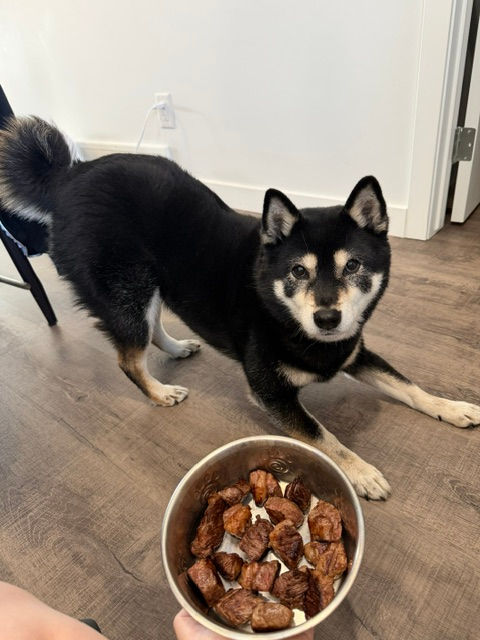
Would that make you feel more relaxed when that person approached your dinner?
Probably not. You'd likely start paying considerably more attention to what they were doing. A dog can learn exactly the same thing: “When someone comes near my food, I might lose it.” That's not resource security.
We want people approaching valued resources to predict safety and good outcomes. Sometimes that means simply leaving the dog alone. Sometimes it might mean casually adding something wonderful to their bowl as you pass. Sometimes it means using a well-practised trade because something genuinely needs to be removed.
What we don't need to do is deliberately create uncertainty just to test whether the dog will tolerate it. There is a lot of dog-training advice online that is described as preventing resource guarding but can actually make a dog less secure about food and possessions.
Before trying a technique designed to address guarding or “dominance” around resources, ask yourself: “Will this make my dog feel more certain that their resources are safe, or less certain?”
If you're unsure, check with us — or, better yet, work with a qualified force-free trainer who can help you understand what your individual dog is communicating and develop a plan that helps them feel more secure.
Pay attention to the dog in front of you
There isn't one resource-management system that's right for every dog. One dog may happily leave a chew on the floor and walk away. Another may be unable to relax until they know exactly where that chew is. One dog may be perfectly comfortable eating with another dog across the room. Another may need a closed door before they can relax enough to eat. One dog may not care when another dog receives affection. Another may become worried about losing access to their person.
Rather than deciding what a dog should be comfortable with, pay attention to what that individual dog is telling you. Ask: “What does this dog need in order to feel secure about this resource?” Sometimes the answer is training. Often, the answer is simply better management and greater predictability.
The goal
We don't need dogs to prove that they'll tolerate having valuable things taken away. We don't need dogs to work out resource conflicts between themselves. And we don't need to wait until a dog is resource guarding before we start thinking about resource security. Instead, we can create an environment where the dog doesn't feel responsible for managing those resources in the first place.
When people manage the resources, dogs don't have to.
Our goal is a dog who trusts that the things they value are safe, predictable and available — and that the people in their life will help keep them that way.


Comments